The role of the ETS
The New Zealand Emissions Trading Scheme (ETS) is the Government’s key tool to help New Zealand meet its:
- international obligations under the United Nations Framework Convention on Climate Change and its Paris Agreement
- 2050 target: net zero greenhouse gas emissions (except biogenic methane) and a 14 percent to 24 percent reduction in biogenic methane2
- emissions budgets: a set of interim targets to reach the 2050 emissions reduction target. Emissions budgets set the total quantity of net emissions allowed to be released during an emissions budget period3
The ETS supports emissions reductions by:
- requiring businesses to measure and report on their greenhouse gas emissions
- pricing emissions and removals to financially incentivise emissions reductions and removals
- requiring businesses to surrender one ‘emissions unit’ – a New Zealand Unit (NZU or unit) – to the Government for each tonne of emissions they are responsible for under the ETS
- rewarding removal activities (mainly forestry) with one unit for each tonne of emissions removed from the atmosphere
- limiting the number of units supplied into the ETS through auctioning and industrial allocation.
ETS participants can access units from several sources:
- government auctions of units
- government allocation of units to agreed emissions-intensive and trade-exposed firms (industrial allocation)
- removal activities that generate units (mainly forestry)
- the stockpile of units – banked units that originated from the above sources and that can now be traded and ultimately surrendered by emitters. This includes ‘surplus’ units, which are not held for future surrender or other purposes, and thus may be sold freely into the market.
The Government sets the number of units and reduces the number supplied into the ETS over time, through auctions and industrial allocation. This limits the total volume of net emissions for ETS participants, in line with New Zealand’s domestic emissions reduction targets.
Participants can buy and sell units among themselves. The unit price reflects supply and demand in the ETS. This price signal allows businesses to make economically efficient choices about how and when to reduce emissions and increase removals.
2 More specifically, a 14 percent to 24 percent reduction below 2017 biogenic methane emissions by 2050, including a 10 percent reduction below 2017 biogenic methane emissions by 2030. The 2050 biogenic methane target was changed from a 24 percent to 47 percent reduction in December 2025, as part of the Climate Change Response (2050 Target and Other Matters) Amendment Act 2025.
3 For more information, see: Ministry for the Environment. Emissions budgets and the emissions reduction plan. Retrieved 15 May 2026.
Annual process for unit limits and price control settings
Under the Climate Change Response Act 2002 (CCRA), ETS unit limits and price control settings (ETS settings) for the next five years are made through an annual update process to the Climate Change (Auctions, Limits, and Price Controls for Units) Regulations 2020. 4
At present, the settings are informed by previous tests of accordance with emission targets and are prescribed for only the next four years. The Government needs to decide on settings for the full five-year period by re-evaluating accordance against domestic emissions reduction targets and considering new information.
The unit settings must accord with New Zealand’s emissions budgets and the 2050 target. 5
Unit limits include:
- a limit on the units available by auction (auction volumes)
- a limit on approved overseas units – currently zero
- an overall limit on units – which consists of units available by auction and industrial allocation and approved overseas units.
The price control settings for units are:
- the auction price floor – the price below which the Government will not sell units at auction
- cost containment reserve (CCR) trigger prices – the prices at which additional units will be released if an auction’s interim clearing price reaches or exceeds this level
- CCR volumes – the number of units that will be released if the trigger price is reached.
Unit limits help constrain the supply of units into the ETS over time. This limits the quantity of net emissions that can occur, in line with New Zealand’s domestic emissions reduction targets.
Price controls set a minimum and maximum price for auctions for the next five years, providing a forward-looking ‘price corridor’.
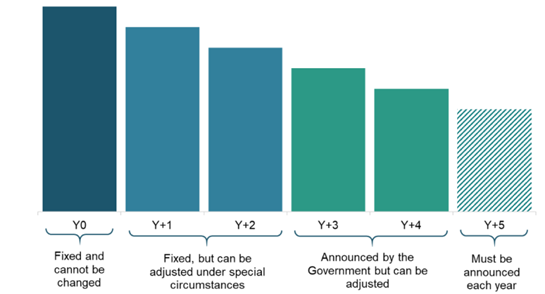
This five-year look-ahead period (figure 1) provides regulatory certainty to ETS participants, supporting investment decisions and market stability. To increase certainty, these updates are generally intended to exclude changes to unit settings for the first two years (ie, 2027 and 2028, from this year). Changes can only be made in specified circumstances for these first two years, for example, if a change significantly affects one of the matters the Minister of Climate Change (the Minister) must consider when recommending changes to settings.6
Figure 1: The five-year rolling process for unit limits and price control settings
4 This reflects the current legal requirement. However, the Government is proposing to shift to biennial ETS settings. The current legal requirement is reflected throughout this document.
5 Unit settings were also previously required to accord with New Zealand’s nationally determined contributions. This requirement was removed as part of the Climate Change Response (2050 Target and Other Matters) Amendment Act 2025.
6 See section 30GB(5) of the CCRA, which includes: “(b) the Minister is satisfied that the amendment is justified by … (i) a change that has significantly affected any matter that the Minister was required to consider under section 30GC when recommending the limits and price control settings that are to be amended”.
Framework review
In late 2025, the Ministry for the Environment (the Ministry) led a targeted review of the frameworks and analytical tools used to develop advice on ETS settings.7 This was done with the close participation of He Pou a Rangi | Climate Change Commission (the Commission).
The review found the overall advisory and analytical frameworks for ETS settings were fit for purpose, but identified several opportunities for improvement for the Ministry and the Commission. These have been incorporated into the Commission’s advice and the Ministry’s settings process, and include:
- Enhancing communication of key judgements and assumptions, helping decision-makers understand their options and the trade-offs.
- Improving clarity in how market conditions have been considered and addressing potential sources of confusion.
- Managing surplus uncertainty and addressing risk.
- Continually improving analytical tools and approaches.
7 Ministry for the Environment. Opportunities to Improve New Zealand Emissions Trading Scheme Advisory Frameworks and Tools. Retrieved 21 May 2026.
Recent secondary market price dynamics
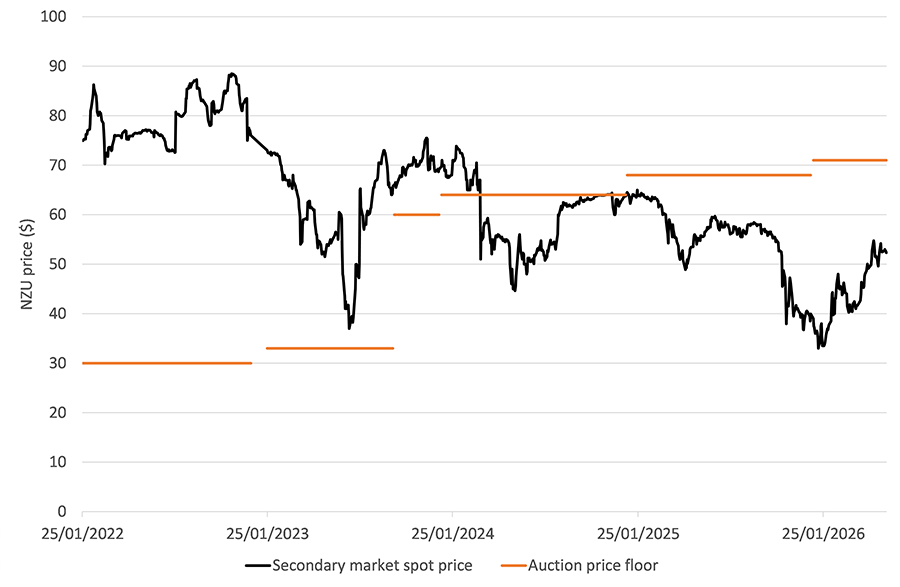
Following Government announcements in November 2025 of changes to the CCRA, there was a material decline in the NZU price and an increase in volatility. Market commentators have attributed the market reaction to reduced market confidence, following several government climate decisions, particularly the change to the 2050 biogenic methane target, removal of plans to price agricultural emissions, and the removal of the requirement for ETS settings to accord with New Zealand’s nationally determined contributions. Although there has been a recovery recently, the NZU price currently remains well below the auction price floor.
The current gap between the NZU price and the auction price floor, and the fact that no 2025 ETS auctions, or 2026 auctions to date, have cleared, suggests that the market remains well supplied in the short term. Market commentators have pointed to a disconnect between current prices and long-term supply and demand fundamentals. They have noted that recent dynamics could indicate the market is more sentiment driven and focused on short-term factors.
Figure 2: NZU secondary market spot price and auction price floors, January 2022 to May 2026
Source: Jarden, Ministry for the Environment
Commission advice on ETS settings
The Commission is required to give annual advice on ETS settings. The Minister must consider the Commission’s advice when recommending updates to settings. If there are any differences between the Commission’s recommendations and those made by the Minister, the Minister must table a report in Parliament to explain the reasons for those differences.
The Commission’s advice on ETS settings was published in April 2026.8 The Commission highlighted that, although it could be possible to increase auction volumes in line with the Government’s emissions budgets, offering those volumes at a time of low market sentiment might further undermine market confidence. It also highlighted the risk of an NZU shortfall towards the end of the 2020s, which could result in rapidly rising and volatile NZU prices. It noted that, if this eventuates, it could unintentionally drive emissions reductions through plant closures and reduced production, rather than by incentivising investments in lower emissions technologies. However, the Commission did also acknowledge uncertainty in the likelihood and possible timing of any shortfall.
Its major recommendations this year are that the Government should:
- maintain the current auction volumes through to 2030, and set 2031 auction volumes on the basis that the surplus of units in the market has been depleted by then
- offer 14.7 million units over the 2027–31 settings period
- prepare to address the risk of a unit shortfall in future years
- extend current price control settings to 2031, with inflation adjustments from 2029.
The Commission also recommended that, if there is no ETS settings update in 2027 because of a shift to biennial settings decisions, the Government should consider adding a new temporary lower CCR tier to mitigate the risk of a shortfall in 2028. The Government has recently announced that the planned shift to biennial ETS settings will take place after the ETS settings update in 2027. For that reason, this recommendation has not been considered.
We are seeking feedback on options for ETS settings. These include the Commission’s recommended approach.
8 He Pou a Rangi | Climate Change Commission. NZ ETS unit limits and price control settings for 2027–2031. Retrieved 24 April 2026.
Market advisory group
In advance of public consultation, the Government sought insights from a market advisory group, consisting of a small number of ETS market stakeholders that the Ministry engaged with individually.
The Ministry gave members a range of potential ETS settings scenarios without indicating any preference. The group provided views on ETS market perspectives, and potential impacts and reactions to different scenarios. This helped inform the options included in the consultation.
The Ministry did not provide members with any summary of their feedback or information about how their views were used.
