Aotearoa New Zealand faces growing pressures from climate change and biodiversity loss. Financing climate change mitigation and nature stewardship is a key challenge. Voluntary nature and carbon markets (voluntary markets) offer a way to channel more private investment into activities that deliver measurable, independently verified environmental benefits.
The Government recently announced its approach to encourage New Zealand’s voluntary markets to grow. The government has a new assurance role to give buyers, landowners and others confidence to invest in voluntary markets by recognising and endorsing high-quality schemes and assessing whether scheme methodologies are scientifically robust.
As a first step, the Government has signalled market integrity by recognising certain international bodies’ accreditation of voluntary schemes and methodologies as a market integrity signal, effective immediately (the international pathway).
As a second step, the Government is developing an endorsement pathway for voluntary schemes developed and operating in New Zealand.
1.1 Purpose and scope
This is a technical document intended for voluntary market participants, particularly voluntary market scheme operators and assurance practitioners.
It sets out the domestic endorsement pathway for voluntary market schemes designed to address New Zealand’s unique environmental challenges and opportunities, to complement the international pathway.
We are seeking feedback on:
- scheme endorsement criteria (section 2)
- explanatory material for the integrity principles (section 3)
- suitability of the criteria for assurance practitioners to assess schemes (appendix 1)
- suitability of the criteria for project validation and verification providers (appendix 2).
The Government intends to publish Version 1.0 of this document in 2026 to support the domestic endorsement pathway to go live. This document may be updated from time to time. Any changes will be signalled to the market in advance.
1.2 Context and overview
The government domestic endorsement pathway
The domestic scheme endorsement process is intended to demonstrate which schemes conform to the New Zealand voluntary markets integrity principles (integrity principles). It is separate to the process for assessing the scientific sufficiency of project methodologies (also currently in development), and project validation and verification. Scheme endorsement provides important integrity foundations for each of those processes.
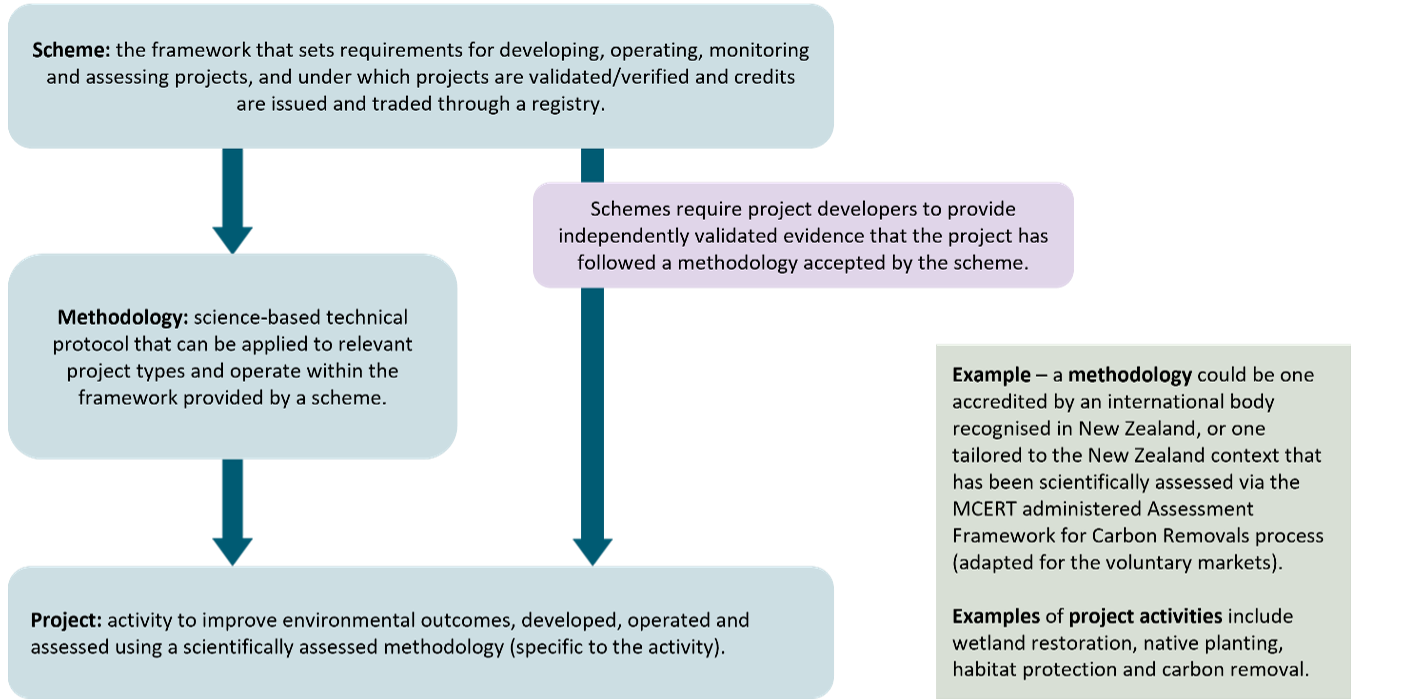
Figure 1 expands on the difference between schemes, methodologies, and projects, illustrating the hierarchy and describing the relationship between them.
Figure 1: Distinctions and relationships between schemes, methodologies and projects
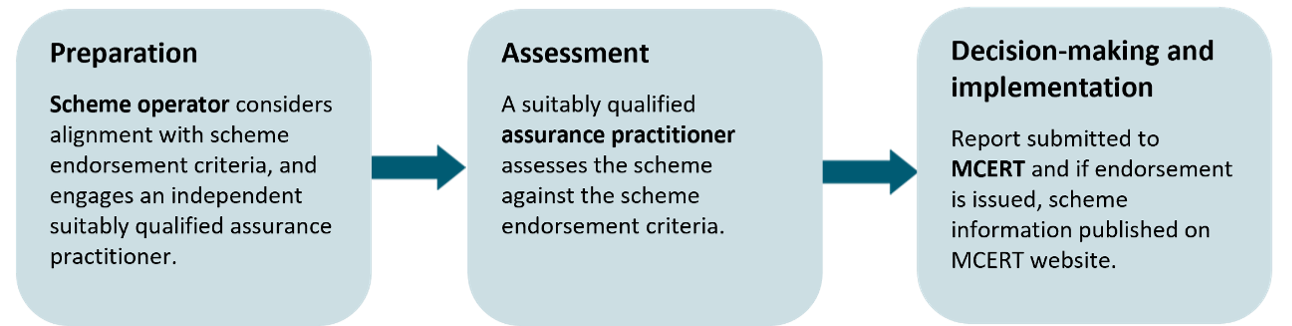
Government endorsement is administered by the Ministry for Cities, Environment, Regions and Transport (MCERT), informed by an assessment undertaken by an MCERT-listed assurance practitioner to demonstrate conformity with the integrity principles and criteria. Key stages in the process are outlined in figure 2.
Figure 2: High-level overview of scheme endorsement process
Government endorsement provides an impartial demonstration that a scheme has governance, rules and infrastructure to:
- provide a certification pathway for projects based on scientifically assessed methodologies
- ensure that the creation of nature and/or carbon credits is based on independent verification of project outcomes by a qualified competent body or person
- provide appropriate public information on certified projects and the credits created.
Each of these elements is necessary to create high-integrity nature and/or carbon credits based on positive project outcomes.
New Zealand voluntary markets integrity principles
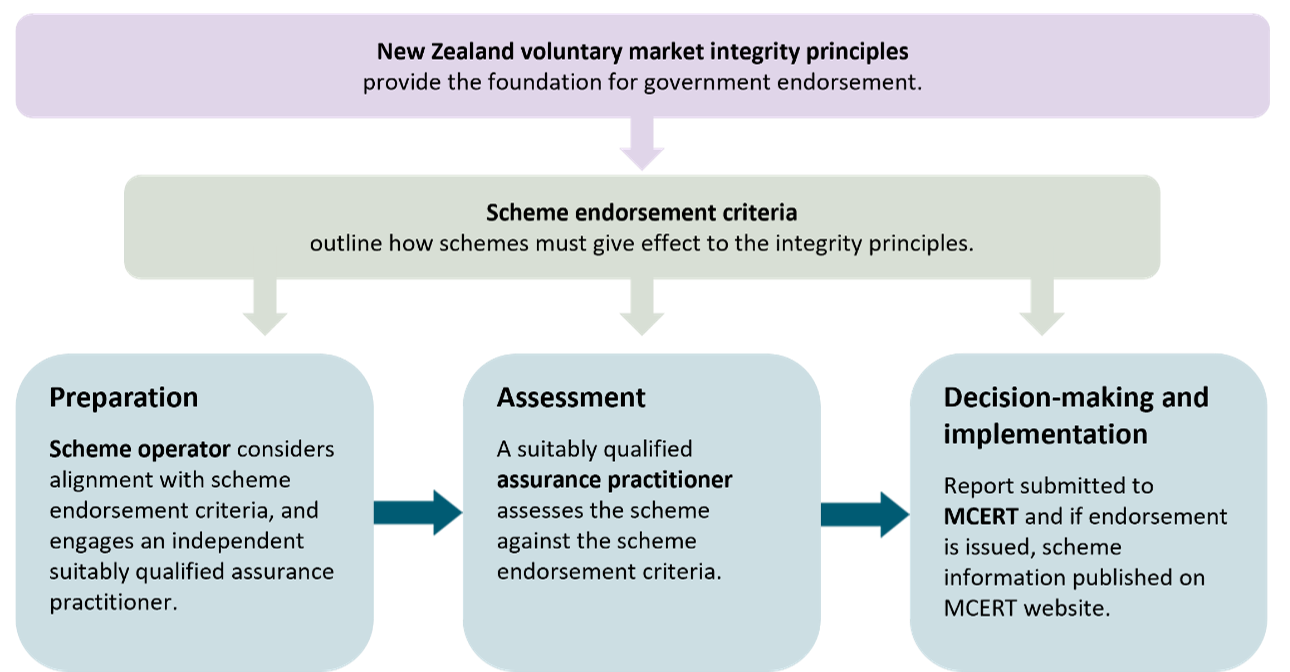
The integrity principles provide the foundation for government endorsement, ensuring that endorsed projects and the credits issued by them give effect to the principles.
The integrity principles were informed by high-integrity principles developed by international standard-setting, advisory and governance bodies for carbon and biodiversity credit markets1 and stakeholder engagement. They are outlined in more detail in section 3.
To support market participants to meet the principles and ensure consistent application of the principles, scheme endorsement criteria have been developed to sit underneath and outline in detail what is required to give effect to the integrity principles. The scheme endorsement criteria are outlined in section 2.
Figure 3 illustrates how the integrity principles and scheme endorsement criteria underpin the process for scheme endorsement.
Figure 3: How the integrity principles and criteria underpin the scheme endorsement process
1 Coalition to Grow Carbon Markets. 2025. Shared Principles for Growing High-Integrity Use of Carbon Credits by Companies and Other Buyers
United Nations Framework Convention on Climate Change (UNFCCC). Undated (live), Paris Agreement Crediting Mechanism (PACM) methodologies
Integrity Council for the Voluntary Carbon Market (ICVCM). 2024. Core Carbon Principles, Assessment Framework and Assessment Procedure, v1.1
International Advisory Panel on Biodiversity Credits. 2024. Framework for high integrity biodiversity credit markets.
