The scheme endorsement process is designed to ensure that the assessment of a scheme’s conformity with endorsement criteria will deliver a consistent level of scheme quality for projects, project outcomes and credit issuance. The integrity principles apply to schemes and by extension, project outcomes and their representation via scheme credits and claims.
The process involves three key parties, which undertake specific roles in the process, as outlined in the following table.
Table A1.1: The agreement model between MCERT, the assurance practitioner and the scheme
| Party |
Role |
Controls |
| MCERT |
Sets criteria, lists assurance practitioners that can be used, receives assessment report from applicant scheme, makes endorsement decision. |
Controls scope, conflict requirements, decision record and publication. |
| Independent assessment/assurance organisation |
Performs conformity assessment of an applicant scheme against the endorsement criteria and prepares report with recommendation. |
Must be impartial, competent, evidence-based and free from unmanaged conflicts. Must nominate competent lead individual. |
| Applicant scheme |
Engages assurance practitioner, provides documents as required, responds to information requests from the assessor. |
May correct factual errors but cannot control findings, report conclusions or recommendation. |
A1.1 Who can seek endorsement?
Operators of schemes that issue nature credits or carbon credits intended for trading on the voluntary markets can apply for MCERT endorsement.
Organisations that develop a specific scheme to implement nature or carbon interventions within its supply chain may seek endorsement to support investment decisions and insetting related claims. Where credits are created as a result of supply chain interventions or insetting, the scheme must demonstrate that no double counting has taken place.
A1.2 Who can provide a scheme assessment for endorsement?
Assessment is undertaken by an assurance practitioner or other suitably qualified and experienced assessment body listed by MCERT.
Scheme assessors may be ISO conformity-assessment bodies (eg, ISO/IEC 17029 accredited, using ISO 14065) or suitably qualified assurance providers (using ISAE 300019 and ISAE 3410) including companies/audit firms able to undertake sustainability assurance (using ISAE 5000).
All endorsement assessment organisations must demonstrate that they either hold internally, or have arrangements with partner organisations to ensure they have, an appropriate level of understanding of Māori rights and interests.
MCERT may establish a process for identifying and assessing suitably qualified assurance practitioners and assessment bodies for inclusion on the scheme assessor list. This may include periodic calls for applications as well as consideration of applications received outside those periods. Inclusion on the list is at MCERT’s discretion and will be subject to applicants meeting the eligibility requirements for assessors.
Eligibility criteria for scheme assurance practitioners are outlined below.
Table A1.2: Eligibility criteria for assurance practitioners
| Criterion |
Minimum expectation |
| Independence and impartiality |
Documented conflict of interest policy; no material conflict with likely applicant schemes. |
| Conformity/assurance capability |
Experience in audit, assurance, certification, compliance review, technical due diligence or comparable assessment. ISAE 5000 capability may be accepted where relevant.
Evidence of repeatable assessment method.
|
| Environmental market expertise |
Must cover domains relevant to the scheme or show access to experts - carbon markets, nature markets, registries, claims, project methodologies, validation/verification. |
| Governance and systems assessment |
Capability to assess governance, data systems, records, registry controls, credit calculation and complaints processes. |
| Lead assurance practitioner capability |
Named lead individual with assessment/assurance experience and suitable competence for the scheme type. |
| New Zealand context |
Knowledge of New Zealand environmental policy, Māori rights/interests, land systems and voluntary market settings. |
| Quality management |
Document control, reviewer independence, complaints handling, confidential information controls. |
| Capacity and timeliness |
Named team, delivery timetable, escalation process. |
| Professional risk controls |
Appropriate liability arrangements, professional indemnity or equivalent protections. |
19 ISAE 3000. 2013. International Standard on Assurance Engagements ISAE 3000. Revised – Assurance Engagements Other Than Audits or Reviews of Historical Financial Information. International Auditing and Assurance Standards Board.
A1.3 What is the process for a scheme seeking endorsement?
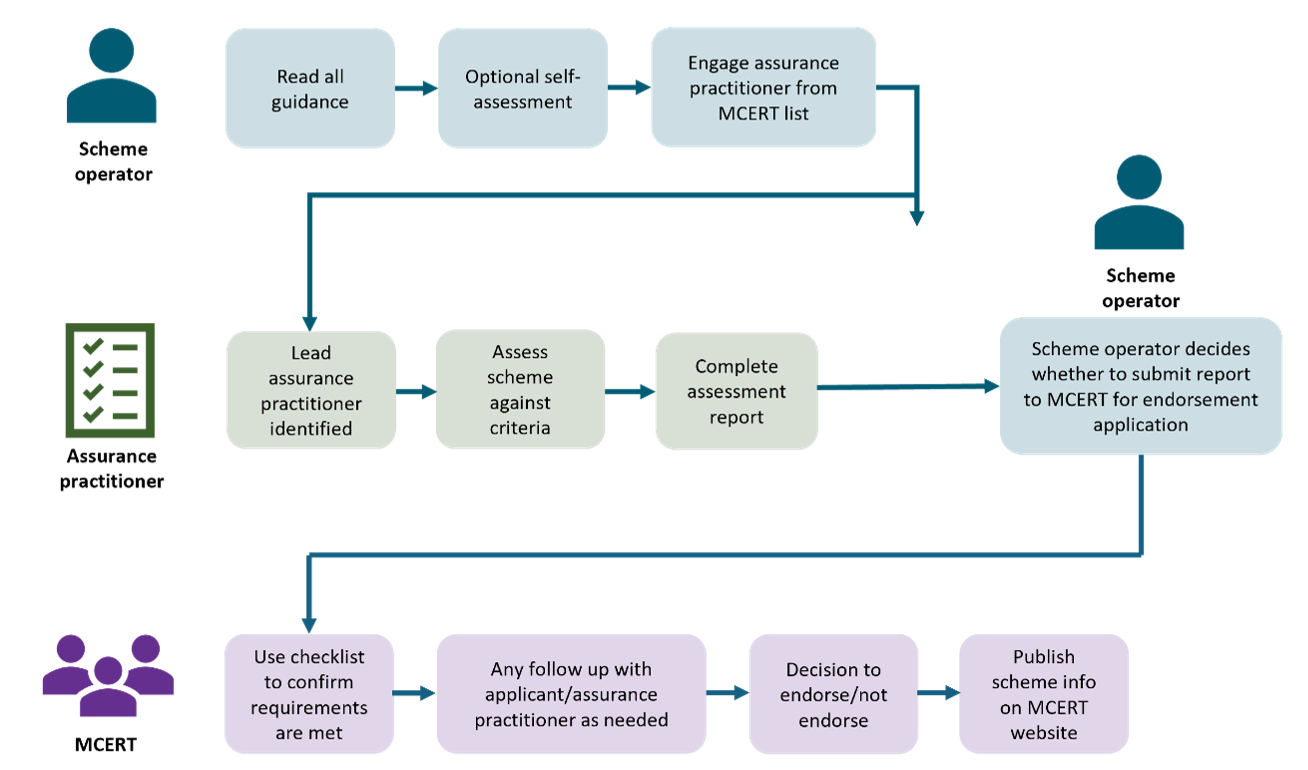
At a basic level, the process is as follows:
- Scheme operators may consider undertaking a readiness self-assessment using information on the MCERT website.
- An applicant scheme may then engage an assurance practitioner from MCERT’s list to undertake an independent conformity assessment against the endorsement criteria.
- The scheme assurance practitioner reports the results of the assessment to the scheme operator.
- The scheme operator decides whether to provide that assessment to MCERT as part of its application for government endorsement.
- MCERT decides whether the scheme meets the scheme endorsement criteria. The scheme application and assessment are kept confidential. Once endorsement has been confirmed, certain scheme information is publicly listed on the MCERT website.
Figure A1.1 illustrates the scheme endorsement process.
Figure A1.1: Scheme endorsement process
A1.4 What should an assessment report cover?
The assessors report should cover the following:
- recommendation
- scope and limitations of assessment
- standards or frameworks applied, including ISO/IEC 17029,20 ISAE 5000 or equivalent where relevant
- documents and evidence reviewed
- applicant and scheme overview
- fit and proper person findings
- governance and conflict management
- methodology approval status
- project registration and operating controls
- data, quantification and credit calculation controls
- validation and verification requirements
- registry and credit tracking
- claims and anti-greenwashing controls
- treatment of pending credits, stacking and reversals
- lead assurance practitioner competence and independence statement
- risk assessment and conditions
- scoring table
- assurance practitioner declaration of independence.
Table A1.3: Scheme endorsement scoring model
| Gate/criterion |
Assessment approach |
| Mandatory |
Pass/conditional pass/fail. Failure should result in rejection or return for revision. |
| Core quality criteria |
0–5 score: 0 not demonstrated, 3 adequate, 5 leading practice. |
| Risk classification |
Low/medium/high; determines post-endorsement reporting and oversight intensity. |
| Decision outcomes |
Endorse; endorse with conditions; defer; revise and resubmit; not endorse. |
20 ISO/IEC 17029: 2019. Conformity assessment – General principles and requirements for validation and verification bodies.
