The measures in options 1 to 3 are focused on the top of the waste hierarchy. That is, they enable us to keep resources in the economy at their highest value, keeping organic material out of landfills, which is at the bottom of the waste hierarchy (figure 3).
Prioritising efforts higher up the waste hierarchy is also an effective avenue to reduce greenhouse gas emissions. For example, preventing food loss and waste across the supply chain reduces greenhouse gas emissions more effectively than dealing with food waste at the end of its life.6
Figure 3: The waste hierarchy7
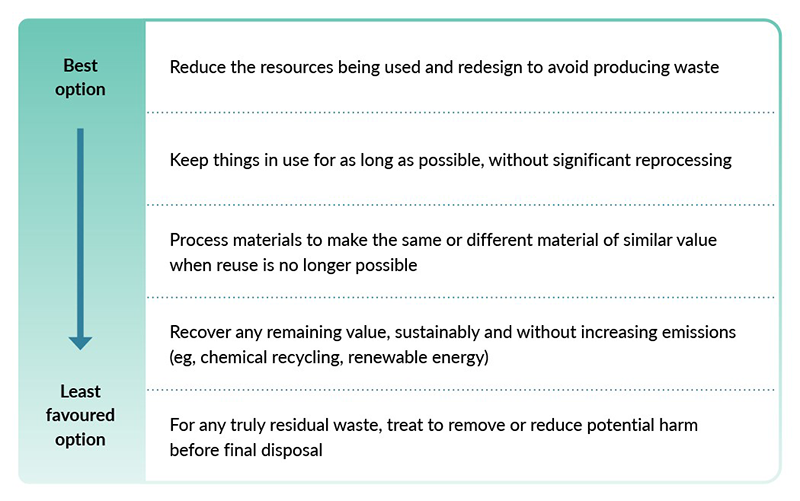
Actions in the higher levels of the waste hierarchy can reduce resource use, gain the greatest value from use of existing resources, and reduce waste. Other co-benefits include:
- reducing financial losses for primary producers, retailers and households
- increasing national economic productivity
- redirecting surplus food to higher value uses, including for people and animals
- producing compost, so that nutrients are cycled back to the land, benefiting soil health and productivity
- producing biogas, which can reduce the demand on other gas supplies.
6 Prime Minister’s Chief Science Advisor. 2024. Preventing Food Loss and Waste in Aotearoa New Zealand: Evidence for action across the supply chain (PDF 7.6MB). Auckland: Office of the Prime Minister’s Chief Science Advisor.
7 Ministry for the Environment. 2025. The Government’s waste and resource efficiency strategy: Minimising waste and improving waste management (PDF 1.5MB). Wellington: Ministry for the Environment.
Audience for organic waste management options
Feedback on the options in part A will be particularly relevant for those who are working to reduce organic waste (including food waste), or who collect and process organic waste to produce compost or biogas. This could include food producers, food processors, retailers and food rescue organisations, as well as territorial authorities, composters and anaerobic digestion operators, and others in the waste and resource recovery sector.
Abatement opportunities from improving organic waste management
Although reducing organic waste or recovering value from waste before it reaches landfill can reduce biogenic methane, quantifying the level of emissions abatement can be challenging. We do not yet have sufficient data available to make robust estimates of the volumes of organic waste being generated or that could be diverted by the specific measures outlined in this document.
Following feedback, we will do further work to calculate projected reductions in emissions to help in prioritising options. We welcome any data on potential emissions reductions for the measures outlined in this document. If you have any such information available, we encourage you to include it as part of your feedback. In addition, this feedback process and other related work are helping to inform potential improvements to waste data.
