Have your say on options to reduce emissions from organic waste

Closes 12 Jul 2026

Message from the Minister for the Environment and Introduction

You can read this section:

Read the message from the Minister for the Environment and the introduction - HTML format

Message from the Minister for the Environment

Reducing emissions from organic waste is an important part of New Zealand’s response to climate change and is a key initiative under the second emissions reduction plan. 

Through the Government’s waste and resource efficiency strategy, we are working to reduce waste at its source, maximise the value we recover from materials and minimise harm to the environment.

Throughout the country, businesses, councils, iwi and communities are already making significant progress. With initiatives ranging from reducing food waste to investing in new processing solutions and improving landfill gas capture, momentum to reduce organic waste and emissions is strong.

The examples highlighted in this document reflect the range of initiatives already underway across the waste, resource recovery and food sectors.

This sector feedback document builds on that foundation. It sets out possible measures to further reduce emissions from organic waste, informed by engagement with stakeholders on where improvements could be made and what support they may need.

Your feedback on the options set out in this document will help us better understand what is practical, effective and achievable across the waste system. Insights from those working on the ground will be critical to shaping how this work progresses.

We welcome feedback on the measures presented, along with any additional perspectives or ideas that may help inform future policy development to reduce emissions from organic waste.

Thank you for taking the time to contribute. 
 
Hon Nicola Grigg
Minister for the Environment

Introduction

The Government is seeking input on possible measures to reduce greenhouse gas emissions from organic waste, in line with its commitment in the second emissions reduction plan (ERP2).1 ERP2 is the Government’s plan to meet the second emissions budget for the period 2026–30, in working towards Aotearoa New Zealand’s target to reach net zero emissions by 2050.

We are engaging early, seeking feedback from stakeholders across the waste, resource recovery and food sectors and others with an interest in waste, with the aim of identifying the most feasible and impactful measures for reducing greenhouse gas emissions from organic waste. Your feedback will help inform potential implementation pathways and planning, including how we could prioritise, phase and resource options. 

1     Ministry for the Environment. 2024. Our journey towards net zero: New Zealand’s second emissions reduction plan 2026–30 (amended January 2026) (PDF 6.6MB). Wellington: Ministry for the Environment.

How to have your say

We welcome your feedback on the options outlined in the document, which you can give by answering any of the questions provided throughout. The Ministry for the Environment (the Ministry) has provided a summary of options and questions on our Citizen Space platform. 

To aid our understanding, where you respond to a question, please explain the reasons for your views and give supporting evidence if needed. We also welcome additional comments on ways to reduce emissions from organic waste.

Please share your views here, rather than emailing feedback. 

If you have questions or want more information, please email waste.emissions@mfe.govt.nz.

Closing date for feedback

Submit your feedback on by 11.59pm, 12 July 2026. 

What happens next?

We will analyse the feedback to help us determine which measures to develop further. Decisions will be required across a range of ministerial portfolios. The Minister for the Environment holds responsibility for the overall waste work programme. 

Releasing your feedback

All or part of any written comments (including names of submitters) may be published on the Ministry’s website, if you consent to this when submitting your feedback on Citizen Space. 

Contents of submissions may be released to the public under the Official Information Act 1982 following requests to the Ministry (including via email). Please advise in the Consent section of Citizen Space if you object to the release of any information contained in your submission and, in particular, which part(s) you consider should be withheld, together with the reason(s) for withholding the information. We will take into account all such objections when responding to requests for copies of, and information on, submissions to this document under the Official Information Act 1982. 

The Privacy Act 2020 applies certain principles about how various agencies, including the Ministry, collect, use and disclose information about individuals. It governs access by individuals to information about themselves that agencies hold. 

Any personal information you supply to the Ministry in making a submission will be used by the Ministry only in relation to the matters covered by this document. Please clearly indicate in your submission if you do not wish your name to be included in any summary of submissions that the Ministry may publish.

Context

New Zealand has committed to both domestic and international greenhouse gas emissions reduction targets. 

Our domestic 2050 target is set through the Climate Change Response Act 2002 and has two separate parts for biogenic methane and all other greenhouse gases: 

  • net zero emissions of all long-lived greenhouse gas emissions (not biogenic methane) by 2050
  • a 14 to 24 percent reduction below 2017 biogenic methane emissions by 2050, including 10 percent reduction below 2017 biogenic methane emissions by 2030. 

New Zealand’s international commitments under the Paris Agreement are to reduce net emissions to:

  • 50 percent below gross 2005 levels by 2030
  • 51 to 55 percent below 2005 levels by 2035.

New Zealand uses a system of emissions budgets and emissions reduction plans to navigate our way towards net zero. Emissions budgets place limits on emissions in five-yearly budget periods and serve as stepping stones towards the 2050 target. Each emissions budget has a corresponding emissions reduction plan, which sets out the policies and strategies that enable New Zealand to meet the target for that budget period. 

The second emissions reduction plan 

ERP2 is a key tool to achieving our emissions reduction commitments and is anchored by the five pillars of the Government’s climate strategy2 (figure 1).

Figure 1: Pillars of the New Zealand Government’s climate strategy 
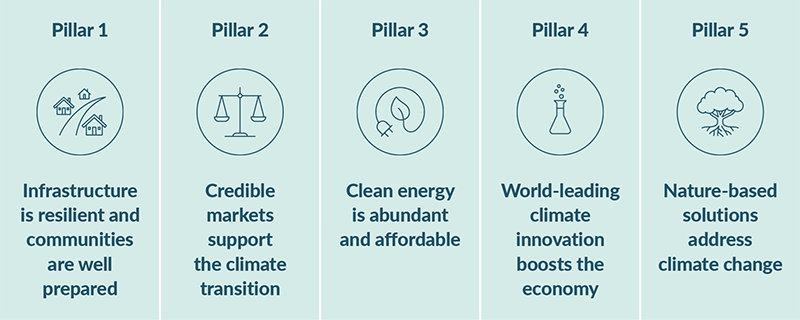
The five pillars of the Climate Strategy. Pillar 1: Infrastructure is resilient and communities are well prepared. Pillar 2: Credible markets support the climate transition. Pillar 3: Clean energy is abundant and affordable. Pillar 4: World-leading innovation boosts the economy. Pillar 5: Nature-based solutions address climate change.

ERP2, released in December 2024 and amended in January 2026, outlines a range of key policies and initiatives to reduce emissions, including initiatives for the waste sector. 

2 Ministry for the Environment. 2024. Responding to a changing climate: The Government’s climate strategy. Wellington: Ministry for the Environment.

Waste sector emissions 

In 2024, the waste sector contributed 4.0 percent of New Zealand’s greenhouse gas emissions and 7.5 percent of its biogenic methane emissions. The solid waste disposal category, which covers all landfill classes,3 was the largest source of waste emissions in 2024, accounting for 77.3 percent of the sector’s total emissions. 

A significant proportion of New Zealand’s organic waste is sent to landfill. Organic waste is estimated to be 42.7 percent of the waste disposed of to Class 1 landfills (9 percent of which is wood, which decomposes much more slowly than other types of organic waste). It contributes an estimated 51.5 percent of the waste disposed of to Class 2 facilities.4

In this document, organic waste typically refers to biodegradable materials that generate methane when disposed of, such as food and garden waste. This document focuses primarily on organic waste from municipal waste streams, as well as relevant organic waste from industrial sources, particularly where it is disposed of to landfill.

Although waste contributes a small percentage of our total emissions, biogenic methane has a potential warming effect 28 times greater than carbon dioxide.5 That makes addressing biogenic methane emission levels an important area for action. 

Emissions reductions within the waste sector will contribute to meeting the 2030 and 2050 targets for biogenic methane emissions. This is important for New Zealand to achieve its overall emissions reduction targets. ERP2 outlines three key areas for action for emissions from waste: 

  • investigating improvements to organic waste disposal and landfill gas capture (the focus of this document)
  • supporting investment through the Waste Minimisation Fund 
  • establishing a regulated product stewardship scheme for refrigerant gases.

3 The Solid Waste Disposal category in the Greenhouse Gas Inventory covers managed solid waste disposal facilities (Class 1 landfills), unmanaged solid waste disposal facilities (Classes 2–5 landfills) and farm fills. 

4 For more information on emissions from the waste sector, see ‘Chapter 7: Waste’, in Ministry for the Environment. 2026. New Zealand’s Greenhouse Gas Inventory 1990–2024 (Volume 1) (PDF 9.2MB). Wellington: Ministry for the Environment. 

5 Methane Review Panel. 2024. Methane science and target review. Wellington: Methane Review Panel.

Purpose of this document

This sector feedback document outlines a suite of possible measures to reduce emissions from organic waste. We are seeking feedback from interested stakeholders on the measures outlined in this document, which cover two themes: improvements to organic waste management (part A) and improvements to landfill gas management (part B) (figure 2). 

Figure 2: Waste initiatives in New Zealand’s second emissions reduction plan

The waste initiatives in New Zealand’s second emissions reduction plan.   The graphic shows six measures, categorised into ‘improvements to organic waste management’ and ‘improvements to landfill gas management’. These are some of the waste initiatives set out in New Zealand’s second emissions reduction plan.    The measures are:   Supporting businesses to reduce and recover food waste   Supporting councils to implement or enhance kerbside organic services   Enabling organic processing solutions, including biogas   Broadening waste sector participation in the ETS   Considering landfill gas management in the new planning system   Improving the accuracy of emissions factors for the waste sector in the ETS   Measures 1-3 relate to organic waste management. Measures 4-6 relate to landfill gas management.   Measures 1-5 are explored in this document. Measure 6 is being consulted on through the ETS regulatory review.

Note: ETS = New Zealand Emissions Trading Scheme

We have developed these measures using a systems approach, considering emissions from organic waste across the whole waste system. The possible measures described are intended to support a range of approaches, rather than prescribe specific solutions. These measures are expected to reduce emissions across different parts of the waste system, with more detailed modelling to be undertaken following feedback and prioritisation. 

Other work is underway to improve landfill gas management, through potential changes to the New Zealand Emissions Trading Scheme (ETS), which we are currently consulting on. Indicative modelling suggests these changes could deliver the greatest reduction in emissions for the waste sector. The measures in this document are intended to complement that work.

Analysis suggests that, of the measures presented in this document, those relating to landfill gas management (part B) are likely to be more effective in reducing emissions than the options for improving organic waste management (part A). In particular, early modelling suggests that refining landfill gas capture regulations in the new planning system could reduce emissions significantly.

Consultation on changes to the New Zealand Emissions Trading Scheme 

We are consulting separately on regulatory measures relating to changes to the ETS as part of the 2026 ETS regulatory review. That consultation includes four proposals potentially impacting the waste sector, as outlined below.

  1. Update the default emissions factor for waste (an action under ERP2).
  2. Stop the use of an oxidation factor when landfills apply for a unique emissions factor.
  3. Increase information requirements for disposal facility operators reporting high-efficiency landfill gas capture using a unique emissions factor (an action under ERP2).
  4. Exempt the disposal of waste resulting from remediation of historic and contaminated sites under the ETS.

The 2026 ETS consultation is open over the same period that we are seeking feedback on this document: 12 June to 12 July 2026. Go to Citizen Space to respond to the ETS regulatory proposals

Prior consultation and engagement 

Actions to achieve emissions abatement for the waste sector have been publicly consulted on through both the first and second emissions reduction plans. 

An informal stakeholder advisory group was established in July 2025, in line with a commitment under ERP2 to work with the sector to design proposals and test feasibility. Insights from the advisory group have helped inform the measures in this document and, where needed, we have sought additional expert advice and stakeholder feedback to refine options.

Further information

The following further information related to the measures outlined in this document is available: